 English
 German
 French
 Russian
 Spanish
 Japanese
 Korean
 Portuguese
 Ukrainian
 Arabic
 Italian
What Type of Laser Is Most Effective for Welding Aluminum Without Porosity?
Welding aluminum presents a unique set of challenges, primarily due to its high thermal conductivity, reflective surface, and the formation of a stubborn oxide layer. One of the most common defects encountered is porosity—tiny gas pockets trapped in the weld bead that weaken the joint. For manufacturers seeking clean, strong, and void-free aluminum welds, the choice of laser technology is critical. At SFX Laser, a leading manufacturer with over 20 years of experience in laser solutions, we know exactly which laser type meets this demand: fiber laser welding, especially when paired with a handheld welding head and proper pre-weld surface preparation.
Why Aluminum Welding Causes Porosity
Porosity in aluminum welds is mainly caused by two factors. First, aluminum has a high solubility for hydrogen when molten, but when it solidifies, hydrogen becomes trapped and forms bubbles. Second, the ever-present aluminum oxide layer has a much higher melting point than the base metal and can trap impurities. Without proper cleaning and controlled welding parameters, these result in unwanted pores. Therefore, any effective laser solution must minimize hydrogen intake and stabilize the molten pool.
The Best Laser Type: Handheld Fiber Laser Welding
For aluminum, the most effective laser type is a fiber laser with a wavelength around 1064 nm. Unlike CO2 lasers, fiber lasers are absorbed significantly better by aluminum, especially once the metal begins to melt. This provides a stable, high-energy-density weld that penetrates deeply without excessive heat input. More importantly, modern handheld fiber laser welding machines incorporate oscillating or swinging beam technology. This oscillation stirs the molten pool, allowing hydrogen bubbles to rise and escape before the metal solidifies, dramatically reducing porosity.
- Higher absorption: Fiber lasers transfer energy efficiently into aluminum's reflective surface.
- Beam oscillation: The wobbling beam action promotes gas escape and produces a smooth, pore-free weld.
- Portability & precision: Handheld systems from SFX Laser enable operators to weld complex joints with consistent control.
- Low heat input: Less distortion and improved metallurgical properties compared to arc welding.
Pre-Weld Cleaning: A Critical Step
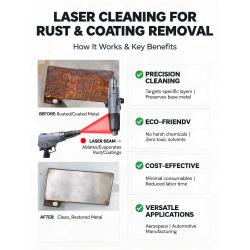
Even with the best laser, aluminum surfaces must be free of oxide layers, oil, and moisture. This is where SFX Laser's continuous laser cleaning machines shine. Using pulsed or continuous laser energy, the surface oxide and contaminants are vaporized, leaving a clean, high-energy surface ready for welding. Integrating laser cleaning before welding is a proven method to eliminate the primary source of hydrogen and porosity.
Process Recommendations from SFX Laser
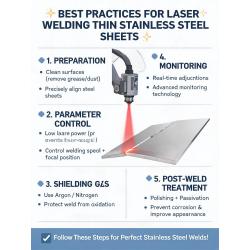
To achieve zero-porosity aluminum welds, SFX Laser recommends the following workflow:
- Pre-clean the aluminum surface with a laser cleaner to remove oxide layer and contaminants.
- Select a fiber laser welder with adjustable oscillation parameters, as offered in SFX Laser's welding machine lineup.
- Use pure argon as a shielding gas with a suitable flow rate to protect the hot weld pool from atmospheric hydrogen.
- Optimize welding speed and power density—the pulsing and wobble functions allow fine-tuning to avoid excessive melting.
- Post-weld inspection to ensure no internal porosity using X-ray or ultrasonic testing.
Conclusion
If you are looking for the most effective laser to weld aluminum without porosity, the answer is clear: a fiber laser welding machine with an oscillating handheld head, combined with laser pre-cleaning. SFX Laser offers a complete line of fiber laser welders and continuous laser cleaners designed for demanding metal processing applications. From our US stock to lifetime online support, we provide the technology and expertise to help you achieve flawless aluminum welds every time. Contact SFX Laser today or visit sfxlaser.com to learn more about our metal processing laser solutions.

Leave A Comment